
At Harley Street Clinic Surrey, every fat transfer treatment begins with an individual surgical assessment. Your surgeon will examine the proposed donor and treatment areas, discuss what you would like to change and explain what the procedure can realistically achieve.
Our doctor-led clinic and CQC-registered Reigate theatres provide a clinical setting in which patient safety, informed consent and personalised care remain central throughout your treatment.
From £3,500
Approximately 1–3 hours
1-2 Weeks
Local / General Anaesthesia
3-20 Years

Fat transfer involves removing fat from one part of the body using liposuction, preparing the harvested fat and carefully injecting it into another area.
Because the procedure uses your own tissue, it is described medically as autologous fat transfer. The transferred fat is used to add volume, improve shape or soften selected contour irregularities without using a synthetic filler.
Fat transfer affects two areas within the same treatment plan. The donor area is contoured through the removal of fat, while the recipient area receives the prepared fat. Common donor areas include the abdomen, flanks and thighs, with the choice determined by your body shape and the amount of fat required.
Not all transferred fat will necessarily establish a lasting blood supply. Your surgeon will account for this when planning treatment, but the amount of fat retained varies between patients. A further procedure can be considered after healing if additional correction is required.
The suitability of fat grafting depends on the area being treated, the amount of donor fat available and the result you hope to achieve.
Fat transfer to the breasts uses your own tissue to add volume, improve symmetry or refine breast shape, with the achievable change assessed individually. It is an option for patients who prefer to use their own tissue rather than breast implants.
The amount of enlargement possible is influenced by the available donor fat, breast tissue and the amount of fat that can be safely transferred. Patients seeking a more substantial increase in breast size may be better suited to breast augmentation with implants.
Fat grafting can address selected dents, depressions or uneven contours following an injury, liposuction or previous surgery, subject to assessment.
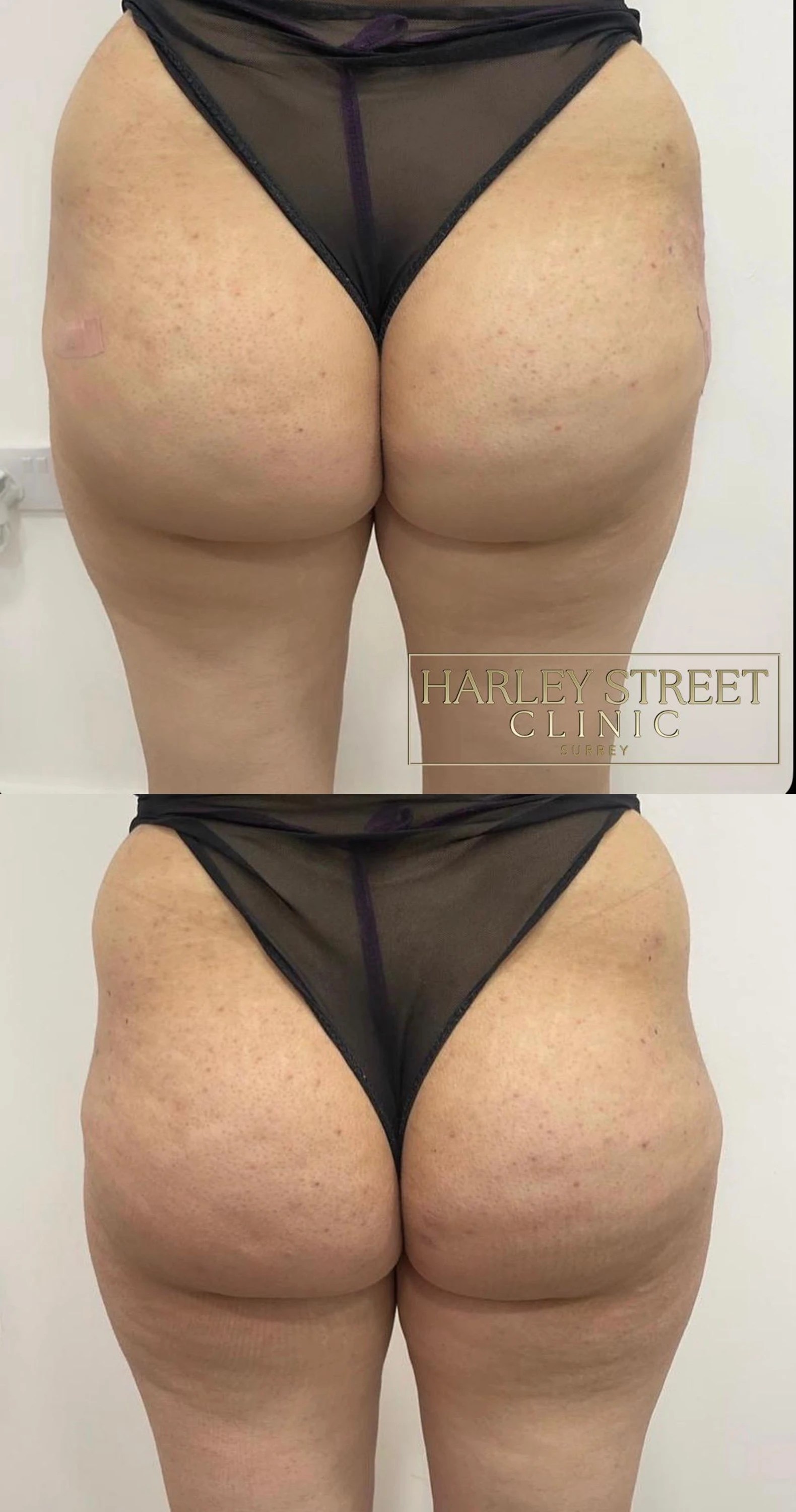
For suitable patients, fat transfer adds volume to hip dips to help create a smoother transition between the waist, hips and thighs.
If your primary concern is unwanted fat combined with loose skin, your surgeon may discuss alternatives such as BodyTite body contouring.
Fat can also be transferred to selected areas of the face to restore volume and soften changes associated with ageing or weight loss.

Improved self-confidence through natural, aesthetically pleasing results.

Restoration of volume and improvement of selected contour irregularities.

Long-lasting results, with effects potentially lasting from 3 to 20 years.

Uses the patient’s own tissue rather than a synthetic implant or filler.
Ability to address multiple areas in one procedure
Fat transfer can offer several potential benefits when it is performed for an appropriate indication.
It uses fat taken from your own body rather than a synthetic volumising material. Treatment can improve the contour of a donor area while restoring volume elsewhere. Once healing is complete, retained fat may provide a soft result that moves naturally with the surrounding tissue.
The procedure also has important limitations. Some transferred fat will usually be reabsorbed by the body, and the retained volume cannot be predicted with complete accuracy. More than one treatment may be required to reach or maintain the intended correction.
The amount of volume that can be added is limited by the available donor fat and the capacity of the recipient tissue. Fat transfer may therefore be unsuitable for patients seeking a large or precisely predetermined increase in size.
Results also remain affected by ageing, pregnancy and changes in body weight. Significant weight loss may reduce the volume of the transferred fat, while weight gain may increase it.
Your surgeon will explain both the potential benefits and the limitations before you decide whether to proceed.

Your consultation will include a review of your medical history, previous procedures, current medicines and treatment goals. Your surgeon will assess the proposed donor and recipient areas and explain what can reasonably be achieved.

Fat is removed from an agreed donor area through liposuction. Small access incisions are made so that a fine cannula can be used to remove the required fat. The harvested fat is prepared to separate suitable fat cells from unwanted fluid and other material.

The prepared fat is then placed into the recipient area in carefully controlled amounts. It is commonly distributed across several tissue levels to support an even contour and help the transferred cells establish a blood supply.

Discharge depends on the extent of surgery, the anaesthetic used and your recovery immediately after treatment.
You will receive instructions covering wound care, garments, medicines, activity and follow-up appointments.
Harley Street Clinic Surrey provides surgical consultations and procedures from its clinical facilities in Reigate. The clinic is doctor-led, and its Reigate theatres are registered with the Care Quality Commission.
An appropriately qualified medical practitioner will complete your suitability assessment. You will have the opportunity to discuss your goals, medical history, procedure, risks, alternatives and expected recovery before deciding whether treatment is right for you.
Our approach is based on individual treatment planning rather than applying the same technique or volume to every patient. The donor and recipient areas must be considered together to create a balanced surgical plan.
All treatments are performed by fully qualified and experienced medical practitioners.

Our clinic is regulated by the Care Quality Commission.
We will follow up with you and take care of any questions you have before or after treatment.
Our doctors are on the General Medical Council's specialist register.
We only use MHRA-approved, market-leading products for all our treatments.

Consultant Plastic, Aesthetic & Reconstructive Surgeon
Aesthetic Surgeon
Consultant Plastic, Aesthetic & Reconstructive Surgeon
Harley Street Clinic Surrey is located in central Reigate, welcoming surgical patients from across Surrey, Sussex, South London and the wider South East.
The clinic is conveniently positioned for patients travelling from areas including Redhill, Epsom, Banstead, Sutton, Croydon, Oxted, Cobham, Leatherhead, Dorking, Guildford, Woking, Crawley, East Grinstead, Horsham, Tunbridge Wells and Sevenoaks.
Use the map below to find the clinic and plan your journey.
Fat transfer prices at Harley Street Clinic Surrey start from £3,500.
Your individual fat grafting cost will depend on the donor area, recipient area, amount of fat being transferred, complexity of surgery, anaesthetic and facility requirements.
The amount required depends on the recipient area, the degree of correction being considered and how much suitable donor fat is available. Your surgeon must also consider how fat removal will affect the shape of the donor area.
A proportion of the transferred fat may be reabsorbed during healing. This can reduce the volume or affect symmetry. Once the result has settled, your surgeon can assess whether further treatment is appropriate.
Fat transfer can sometimes be repeated after the treated tissues have healed. Suitability will depend on the result of the first procedure, your health and the amount of donor fat still available.
Slim patients may still be suitable if enough fat can be safely harvested. However, limited donor fat can restrict the amount of volume that can be transferred.
Selected depressions, contour irregularities or areas of asymmetry may be suitable for fat grafting. Your surgeon will need to examine the area and understand the previous procedure before advising whether correction is possible.
Fat transfer may be considered to soften selected hip contour depressions where sufficient donor fat is available. Suitability depends on your anatomy, the amount of fat available and the area requiring treatment. The surgeon will assess whether fat transfer is appropriate and explain the achievable degree of correction.
Breast fat transfer is generally used to achieve a subtle or moderate increase rather than a large, predetermined change in cup size. The result depends on your existing breast tissue, available donor fat, tissue capacity and how much of the transferred fat remains after healing.
Fat transfer can cause changes such as fat necrosis, cysts or calcification, which may appear on future breast imaging. You should tell your breast screening team or radiologist that you have previously undergone breast fat transfer. Your surgeon will discuss any appropriate breast assessment before surgery.